
SERVICES
Disease Models
In vivo efficacy models across inflammation, neurodegeneration, metabolic disease, and oncology
Well-characterized rodent models, benchmarked against standard controls, with comprehensive readouts and flexible study design. When you need a model we do not list, our scientists validate it from the literature.

Readouts across models
Most models share a common set of readouts, which we combine to fit the question.
Clinical scoring, body weight, and disease-specific measurements
Flow cytometry and immune cell profiling
Histopathology and immunohistochemistry
Cytokine and chemokine profiling
Clinical chemistry and hematology
Gene expression analysis
PK/PD sampling and bioanalysis in plasma, tissue, and CSF
Study design
Prophylactic, semi-prophylactic, and therapeutic regimens, with defined diets where reproducibility matters. A defined low-fiber diet, for example, raises incidence and reproducibility in autoimmune models such as EAE and CIA.
Therapeutic areas
Examples of established models

Tumor microenvironment.
Oncology
Syngeneic and xenograft tumor models, subcutaneous and orthotopic, characterized for chemotherapy and immunotherapy including checkpoint inhibitors. Tumor growth, immune composition by flow cytometry, and compound distribution.
Get in touch

CIA and CAIA mouse models.
Rheumatoid arthritis
Collagen-induced (CIA) and collagen antibody-induced (CAIA) models, with dexamethasone and etanercept controls. Clinical scoring, joint histology, flow cytometry, and cytokine analysis.
Get in touch

Healthy vs fatty liver.
NAFLD, NASH, and fibrosis
Diet-induced models (MCD, CDAA, HFD, CDHFD, with optional toxins) across mouse and rat strains, sensitive to FXR agonists and PPARγ activators. Lipid and glucose homeostasis, liver enzymes, fibrosis, and histopathology.
Get in touch

Healthy vs progressed AD.
Alzheimer's disease
APPPS1 and APP23 transgenic models of amyloid pathology and cognitive decline. Novel object recognition, PET-MRI, amyloid and tau IHC, and soluble amyloid-beta measurement.
Get in touch

Gut homeostasis vs lesion.
Inflammatory bowel disease
DSS-induced colitis, acute and chronic, and the adoptive T-cell transfer model. Body weight, colitis and stool scores, colon length, histology, and cytokine profiles.
Get in touch

Healthy vs psoriatic skin.
Psoriasis
Imiquimod-induced psoriasis resembling human plaque disease through the IL-23/IL-17 axis. Skin scoring and thickness, histopathology, and cytokine analysis.
Get in touch

EAE clinical scoring.
Multiple sclerosis (EAE)
MOG/CFA-induced experimental autoimmune encephalomyelitis in C57BL/6 mice, a robust 25 to 30 day model with a wide therapeutic window. Clinical scoring of paralysis, with prednisolone or dexamethasone controls.
Get in touch
Ultrasound and microsurgery
Some research questions are best addressed by observing disease progression within a living animal. High-resolution ultrasound enables non-invasive imaging of organs and blood vessels, while microsurgical techniques allow the creation of vascular disease models that do not occur spontaneously. Together, these approaches make it possible to induce a specific pathological condition and monitor its development, as well as its response to therapeutic interventions, longitudinally within the same animal.
Ultrasound imaging

Prenatal ultrasound imaging.
High-resolution ultrasound provides non-invasive, longitudinal imaging and supports a wide range of applications, including cancer monitoring, prenatal and fetal development studies, vascular and cardiovascular research, cerebral blood vessel imaging, and inflammatory diseases such as psoriasis.

Accurate estimates of skin inflammation via ultrasound
Depending on the scientific objective, disease models can be established using a variety of approaches, including genetic modification, pharmacological or dietary interventions, cell transplantation, and microsurgical techniques. Longitudinal ultrasound imaging can then be used to monitor disease onset and progression, evaluate physiological and anatomical changes, and assess responses to therapeutic interventions. We would be pleased to discuss your research goals and connect you with our scientists to identify the most suitable animal model, disease induction strategy, and imaging approach for your study.
Microsurgical models
Some disease models have to be created surgically. Our team performs microsurgery to induce vascular disease directly, including aneurysm and stenosis. In our elastase-induced abdominal aortic aneurysm model, the enzyme is applied to a short segment of the aorta to weaken its wall, and the vessel then widens over the following weeks. Because ultrasound is non-invasive, we follow the same animal across the study, measuring how the aortic diameter and wall stiffness change with treatment, and we confirm the result with histology of the vessel wall.
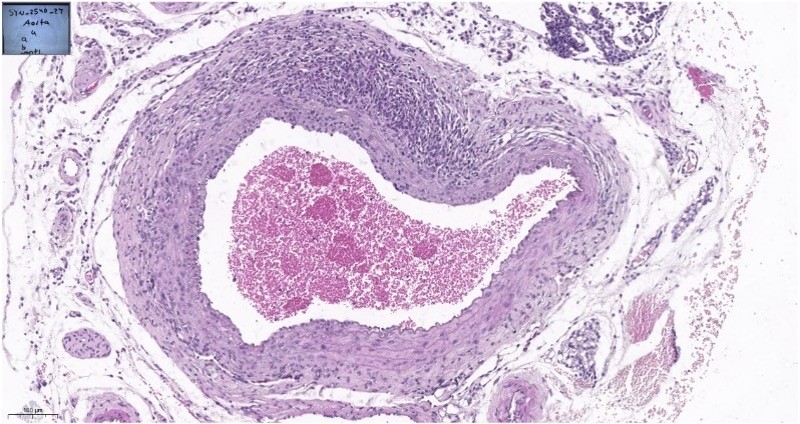
Aortic histology stained with Verhoeff-Van Gieson (VVG).
Behavioral testing
Behavioral tests measure how an animal acts, which is often the most direct readout of how a disease or a treatment affects the brain and nervous system. We use them alongside our disease models, particularly in neurodegeneration and other CNS work. The tests are non-invasive and can be repeated, so changes can be followed over the course of a study.
Cognitive and memory tests
Novel object recognition (NOR) tests recognition memory. A mouse that remembers a familiar object spends more of its time exploring a new one, so the difference reflects what it recalls. The Y-maze tests spatial working memory from how a mouse moves between the arms of a Y-shaped maze, since an animal with intact memory tends to enter the arm it visited least recently. Nest building is a simple, sensitive measure of well-being and hippocampal function, scored from how completely a mouse builds a nest from the material it is given.
Motor function and coordination
The rotarod measures motor coordination and balance from how long a mouse stays on a slowly accelerating rotating rod. Grip strength measures neuromuscular strength from the force a mouse applies as a bar is gently pulled from its grip. The open field test places a mouse in an open arena and records its locomotion and exploration, which reports on general activity and also on anxiety-like behavior, since more anxious animals keep to the walls rather than crossing the center.
Discuss a study
Tell us the indication, the model, and the readouts you need. We can propose a design and an individual quote, including models we validate from the literature.
Get in touch